The word “sustainable” has a problem. It has been stretched so far by so many brands that it now covers everything from a token recycled hang-tag to a genuinely transformed supply chain — and the person trying to make a more considered purchase has no reliable way to tell the difference from a product page. When it comes to sustainable knitwear specifically, this gap between claim and reality is particularly wide, because sweaters involve multiple stages of production — fiber sourcing, spinning, dyeing, knitting, finishing — each with its own environmental footprint, and most brands only address one or two of them in their marketing. This guide cuts through the noise. We will show you exactly which criteria actually define sustainable knitwear, how to evaluate a brand or product against them honestly, and why the pieces we make at Sweater Wardrobe hold up against every one. Discover our approach to sustainable knitwear design.

The Six Criteria That Define Genuinely Sustainable Knitwear
1. Natural Fiber Content — The Foundation of Everything
The single most important factor in sustainable knitwear is the fiber itself. Synthetic fibers — polyester, acrylic, nylon — are petroleum-derived, shed microplastic particles with every wash, and do not biodegrade at the end of their life. A sweater presented as “sustainable” that is primarily acrylic is, in environmental terms, a plastic garment with a marketing problem.
Natural fibers — cotton, wool, cashmere, alpaca, linen — are biodegradable, renewable, and do not shed microplastics. They breathe naturally, regulate temperature, and in the case of animal fibers like cashmere and wool, improve with careful wear over time. When evaluating any knitwear purchase, the fiber content label is the first thing to read. Look for pieces that are primarily natural fiber: 100% cotton, 100% cashmere, or blends in which the natural fiber content is dominant and purposeful rather than cosmetic.
At Sweater Wardrobe, our most sustainable knitwear pieces lead with natural fiber in their construction. The 100% Cashmere Short-Sleeve Sweater is exactly what it says: pure cashmere, no synthetic additions, a fiber that grows on a goat, biodegrades naturally, and produces no microplastic waste across its life. The Gray Fair Isle Cotton Sweater and Red Fair Isle Christmas Sweater are both 100% cotton — a plant fiber that is renewable, breathable, and fully biodegradable. These are not marketing numbers. They are the actual composition of what you are buying. Shop the cashmere sweater here, $69.

2. Longevity Engineering — The Most Underrated Sustainability Factor
The most sustainable garment you can own is one you do not have to replace. This sounds obvious, and yet it is the criterion most frequently overlooked in sustainability discussions — which tend to focus on production practices while ignoring whether the piece will actually last. A sweater made from recycled materials that pills into unwearability after six washes has a worse environmental footprint than a conventionally produced sweater that lasts fifteen years. The math on this is not complicated.
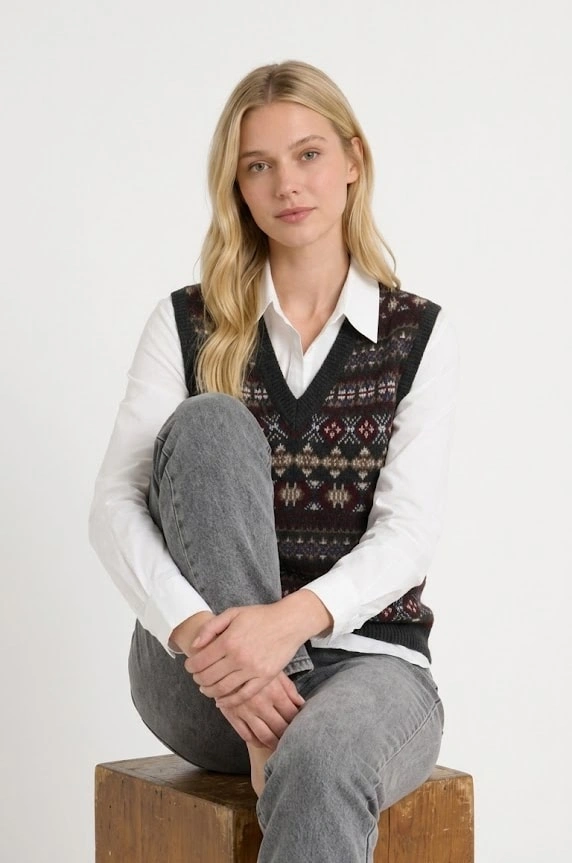
Longevity engineering in knitwear means designing against pilling, stretching, and shape loss from the fiber selection stage. Anti-pilling cotton constructions, tightly structured knit patterns, quality fiber that holds its surface across repeated washing cycles — these are the technical decisions that determine whether a sweater lives in your wardrobe for a decade or ends up in a landfill by next spring. Our Gray Fair Isle Cotton Sweater is built around this principle: the 100% anti-pilling cotton construction is specifically engineered to resist the friction-caused surface degradation that ends most cotton knitwear’s life prematurely. The Fair Isle knit structure itself — tight, dense, interlocking — adds structural stability that a simple stockinette construction cannot match. This piece is designed not just to look good now but to look the same in year five. That longevity is sustainability in its most direct form. Explore this piece, $89.
3. Water-Saving Production — Where Most Brands Fall Short
Textile dyeing is one of the most water-intensive and water-polluting processes in all of manufacturing. Conventional dyeing methods require enormous volumes of water — both in the dyeing process itself and in the rinsing required afterward — and the discharge from conventional dye processes is a significant source of water contamination in many textile-producing regions. A brand that claims sustainability without addressing its dyeing practices is leaving the most significant environmental chapter in its production story unwritten.
At Sweater Wardrobe, water-saving dyeing is a production commitment, not a footnote. The dyeing processes in our supply chain are specifically designed to minimize water consumption and the chemical load of wastewater discharge. This is a process-level commitment that does not show up on the hang tag but shows up in the environmental footprint of every piece we make. It is also, notably, the kind of production decision that can only be made by a brand with genuine control over and transparency into its supply chain — which is a sustainability indicator worth noting in itself.
4. Energy-Efficient Production — The Quiet Footprint
Every stage of knitwear production — spinning, knitting, finishing, pressing — consumes energy, and the source of that energy determines its carbon footprint. Energy-efficient production means both consuming less energy per garment and, where possible, sourcing from cleaner energy inputs. This is not a factor that most consumers can verify from a product page, which makes brand transparency about production methods more important as a trust signal than any specific certification.
Sweater Wardrobe‘s commitment to energy-efficient production is built into our manufacturing relationships. We work with producers who apply energy-saving practices across the knitting and finishing stages — not as an occasional initiative but as a standard operating principle. The result is a production process with a meaningfully lower energy footprint per garment than conventional knitwear manufacturing, and a supply chain that we can speak to with confidence rather than vague aspiration.
5. Designed for Longevity — Timeless Aesthetics That Resist Obsolescence
Sustainable fashion is, at its core, slow fashion — the deliberate rejection of the trend cycle that produces garments designed to feel outdated in twelve months. A truly sustainable sweater is one whose design is not pegged to a single season’s mood board. It looks right this year and next year and in five years, because it was designed around enduring aesthetics rather than reactive trend chasing.
This is a design philosophy we take seriously at Sweater Wardrobe. The Nordic Fair Isle pattern has been beautiful for centuries and will remain beautiful for centuries more. The cable-knit construction is a heritage technique that reads as timeless in any decade. The classic crewneck in pure cashmere is a form that has not required reimagining since it was first made. When you buy something from our collection, you are buying something that does not need to be replaced when the trend cycle moves on — because it was never captive to the trend cycle in the first place.
6. Knowing What Blends Mean — Reading Beyond the Label
Not every blended fiber sweater is unsustainable. Some blends serve clear purposes: adding nylon to a wool-blend increases durability and reduces pilling; adding a small amount of acrylic to a cotton knit can improve shape retention in constructions that would otherwise stretch. The question to ask is whether the synthetic content is purposeful and minimal or whether it is primarily a cost-cutting measure that displaces natural fiber without a functional justification.
Our Wool-Blend Fitted Knit Two-Piece Set is an honest example of purposeful blending: wool content provides warmth and moisture management; the additional fibers — acrylic, nylon, PBT — add shape retention, reduce scratchiness, and improve washability in ways that make the garment more durable and more wearable across its life. The synthetic content is not dominant and is not there to make the piece cheaper. It is there to make the piece better. This is the distinction worth understanding when reading knitwear labels: what is the synthetic content doing, and does the garment genuinely need it to perform as intended?
Your Sustainable Knitwear Buying Checklist
Before adding any sweater to your cart, run it through these six questions. The answers will tell you more than any sustainability claim on the brand’s homepage.
What is the fiber? Is it primarily natural — cotton, wool, cashmere, alpaca? Or is synthetic fiber dominant? If acrylic or polyester makes up more than a third of the composition with no clear functional justification, that is a meaningful flag.
Is it engineered to last? Does the brand or product description mention anti-pilling construction, quality yarn selection, or structural decisions designed for longevity? Or does the description focus only on aesthetics? A piece designed to look good rather than to last is not a sustainable purchase regardless of its fiber content.
Does the brand address its production practices? Look for specific language about dyeing, finishing, and energy use — not just vague commitments to “eco-conscious production.” Specificity in production claims is a meaningful signal of whether those claims are real.
Is the design timeless or trend-reactive? A sweater you will wear for ten years is ten times more sustainable than one you will wear for one. Ask honestly whether this piece is something you will still want in five years, or whether you are responding to a moment.
Is the price honest? Genuinely sustainable knitwear costs more to produce than fast-fashion alternatives, and that cost shows up in the price. A $20 cashmere sweater is not what it claims to be. Sustainable quality at accessible price points exists — our collection proves it — but it exists in a realistic range, not at prices that require cutting corners in materials or labor to achieve.
Will you actually wear it? The most sustainable choice is always the one that gets worn. A piece that sits in your wardrobe unworn because it does not quite work with anything you own is environmentally worse than nothing. Buy what you will reach for.
How Sweater Wardrobe Measures Up — Piece by Piece
Every piece in our collection passes the checklist above. Here are the four pieces that most clearly embody our sustainable knitwear commitments in their actual construction.
The Gray Fair Isle Cotton Sweater ($89): 100% natural cotton fiber, anti-pilling construction engineered for decade-long wear, a Nordic geometric pattern that has been beautiful for generations and will remain so. This is sustainable knitwear in its most complete form: natural fiber, longevity engineering, timeless design.
The 100% Cashmere Short-Sleeve Sweater ($69): Pure cashmere — the finest natural fiber in knitwear. Biodegradable, renewable, no synthetic content, and a fiber that improves with careful wear over time. At this price point for genuine cashmere quality, it is also proof that sustainable natural fiber does not have to be inaccessible.
The Family Matching Dala Horse Sweater ($59–$69): 100% cotton in a raglan construction built for genuine family life — regular washing, real children, everyday wear across all sizes from toddler to adult 3XL. The 100% cotton fiber means no microplastic shedding; the cotton construction is designed for washability and durability. This is sustainable knitwear for the long game of family dressing. Shop this piece here.
The Wool-Blend Fitted Knit Two-Piece Set ($69): A purposeful blend in which wool provides genuine thermal performance and moisture management, and complementary fibers add the durability and washability that make the garment genuinely long-lasting. Five color options in a classic fitted silhouette that will not be obsolete next season or the season after.
What Conscious Shoppers Are Saying
“I’ve been trying to buy less and buy better for the past three years. The Fair Isle cotton sweater is the piece I keep coming back to as an example of what that actually means in practice. It still looks exactly like it did the day I got it. No pilling, no shape loss, no color fading. This is what sustainable really looks like.” — Lauren K., Portland, OR
“The cashmere sweater was my first time buying pure cashmere and I was worried it would require too much maintenance to be worth it. It has not. I hand-wash it every five or six wears and it gets softer every time. The natural fiber story is real — this is not plastic pretending to be cozy.” — Jessica M., Seattle, WA
“I appreciate that Sweater Wardrobe is transparent about their production practices without making it the whole identity of the brand. The sustainable production matters to me, but what keeps me buying is that the pieces are genuinely beautiful and genuinely well-made. Both things can be true.” — Diana R., Austin, TX
Shop with Intention. Choose Knitwear That Lasts.
Sustainable knitwear is not a marketing category. It is a standard — one that shows up in fiber choices, production processes, longevity engineering, and design philosophy simultaneously. At Sweater Wardrobe, every piece we make is held to this standard from the first fiber selection to the finished garment. Our collection ranges from $39 to $89, with free domestic US shipping on every order over $69 and a 30-day return policy that lets you be sure you have found the right piece. Shop once. Keep it for years.
Have questions about the materials or production practices behind a specific piece? We are always happy to answer them honestly.