The difference between a sweater that looks like it cost $300 and one that looks like it cost $39 is rarely the sweater itself. More often, it is the gap in how they are styled — the proportion, the tuck, the collar reveal, the bottom pairing, the one detail that signals intentionality rather than default. Styling is the skill that multiplies the value of what you already own, and when it comes to knitwear specifically, a few well-understood principles make an outsized difference. At Sweater Wardrobe, we have spent a great deal of time thinking about how our pieces perform at their best — and we want to share that thinking with you directly. Here are ten knitwear styling rules that apply to every sweater in our collection, and every sweater in yours. Discover the brand behind the tips.

Proportion & Silhouette: The Foundation of Knitwear Styling
Rule 1: Match the Scale of Your Sweater to the Scale of Your Bottom
This is the single most important knitwear styling rule, and the one most frequently violated. An oversized sweater paired with skinny jeans creates a visual imbalance — all the volume is at the top, with nothing to anchor it at the base. An oversized sweater paired with a wide-leg jean creates visual harmony: both pieces are generous in their scale, and the silhouette reads as intentional rather than accidental.
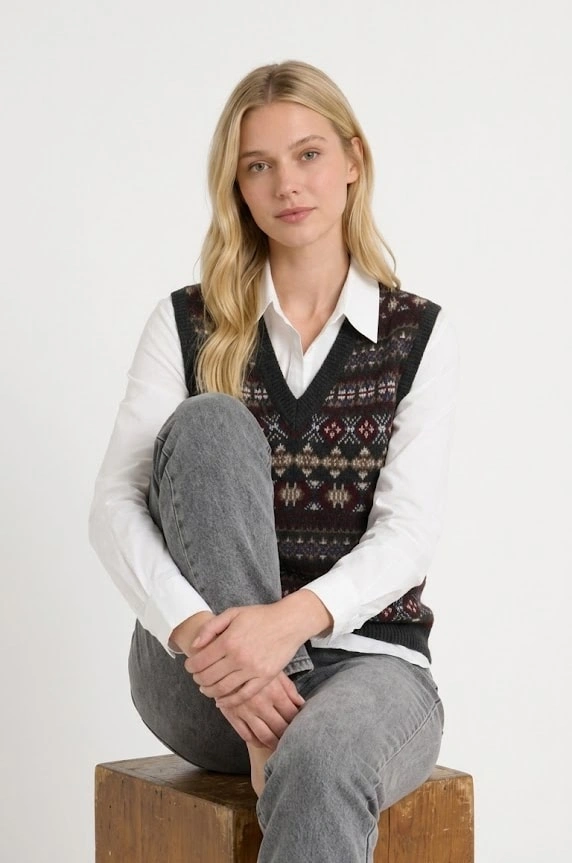
In practical terms: when you wear the Gray Fair Isle Cotton Sweater — which is intentionally oversized in its cut — always pair it with the Retro High-Waist Wide-Leg Jeans rather than anything slim. The wide leg matches the volume of the sweater, the high waist creates a defined point of transition between the two pieces, and the result is a silhouette with genuine visual logic. The same sweater with slim pants looks like you borrowed something several sizes too large. The same sweater with wide-leg pants looks like you understood exactly what you were doing.
Rule 2: The Half-Tuck Changes Everything
Tucking a sweater fully into trousers or jeans can look stiff and try-hard, particularly with heavier knits. Not tucking at all can leave an outfit looking unresolved and shapeless at the waist. The half-tuck — where you pull just the front portion of the sweater slightly into the waistband, leaving the back and sides untucked — is the solution that creates shape and waist definition without the formality of a full tuck.
This technique works particularly well with fitted knits. The Short-Sleeve Turtleneck Sweater in off-white, half-tucked into the Retro High-Waist Wide-Leg Jeans, creates a silhouette that looks like the result of deliberate styling effort while taking approximately three seconds to execute. The slight front tuck signals intention. The relaxed sides and back communicate ease. That combination is the sweet spot of knitwear styling.
Rule 3: Let Texture Simplify Everything Else
When your sweater has strong visual texture — like the raised cable pattern of the Chocolate Brown Cable Knit Half-Zip Sweater, or the interlocking geometric pattern of the Gray Fair Isle Cotton Sweater — the rest of the outfit should step back and let it speak. This means plain, unembellished bottoms (dark denim, solid-color trousers), minimal accessories, and no competing prints. A heavily textured sweater is the visual anchor of any outfit it inhabits. Trying to add more visual interest around it creates noise rather than style. Trust the texture. Let it do the work.
Rule 4: The Fitted-Under-Oversized Layering Rule
When layering two knit pieces — a base layer beneath a cardigan or outer knit — the proportions work best when the base layer is significantly more fitted than the outer layer. A fitted base creates a clean underlayer that makes the outer piece look considered rather than bulky. A fitted turtleneck beneath an open cardigan creates visual depth and interest; two similar-weight knits layered together create bulk without intention.
The Wool-Blend Fitted Knit Two-Piece Set is designed around this principle. The fitted knit vest serves as the precise, close-to-body underlayer; the structured cardigan is the outer frame. Worn together, the proportional contrast between the two creates an outfit with dimension and depth. Worn separately, each piece functions as its own complete look. The layering logic was built into the design from the beginning. Explore the set here, $69.

Color Logic: How Palette Makes Knitwear Look Considered
Rule 5: Build Around the Sweater’s Temperature, Not Its Color
Colors have a temperature — warm tones (camel, chocolate brown, rust, cream) and cool tones (gray, navy, forest green, black) — and the most polished outfits are built within a single temperature family rather than mixing across it. A camel-brown turtleneck paired with warm retro-blue denim reads as naturally harmonious because both belong to the warm side of the palette. The same camel paired with a cool charcoal trouser creates a subtle friction that stops the outfit from feeling entirely resolved.
In practice: the Short-Sleeve Turtleneck Sweater in camel brown belongs with warm-toned neutrals — earth-tone denim, cream, ivory, warm tan. The 100% Cashmere Short-Sleeve Sweater in gray belongs with cool neutrals — true black, dark charcoal, cooler-wash denim. This is not a rigid rule, but understanding it explains why some outfits feel complete and others feel slightly off even when the individual pieces are beautiful.
Rule 6: Mono-Tonal Dressing Is the Fastest Route to Looking Expensive
Wearing different shades of the same color — what stylists call tone-on-tone or mono-tonal dressing — is one of the most reliable techniques for creating an outfit that looks deliberately styled. It creates a sense of cohesion that multi-color outfits often struggle to achieve, and it makes individual pieces look more considered precisely because they are contributing to a unified whole rather than competing for attention.
The Wool-Blend Fitted Knit Two-Piece Set in coffee brown, paired with warm-toned wide-leg trousers or the Retro High-Waist Wide-Leg Jeans in a brown-adjacent wash, creates a mono-tonal palette that is genuinely striking in its simplicity. The dark hemp grey version of the same set with black or charcoal denim achieves the same effect in a cooler register. Try it once and notice how immediately polished it looks.
Rule 7: One Neutral, One Rich — The Two-Color Rule for Patterned Knits
When you wear a patterned sweater — a Fair Isle, an argyle, a cable knit with color detail — the most reliable approach is to pick up one color from the pattern and pair the sweater with a clean neutral that does not compete with it. This lets the pattern read clearly without the outfit becoming visually chaotic. The Gray Fair Isle Cotton Sweater has a dark gray base with lighter pattern elements — any clean neutral (black, cream, dark blue denim) works as the bottom pairing. The pattern gets the visual attention it deserves; the bottom provides a clean stage for it to perform on.
Details & Accessories: The Finishing Touches That Separate Good from Great
Rule 8: Match Your Accessories’ Register to Your Sweater’s Register
Every sweater sits at a point on a register from relaxed to refined. A chunky oversized cable knit sits at the relaxed end; a fitted cashmere crewneck sits at the refined end. The mistake is pairing accessories from the wrong register with the sweater you are wearing. Chunky gold jewelry with a fitted cashmere sweater looks like you dressed up and then accessorized down. Delicate fine jewelry with an oversized cable knit disappears entirely — the texture of the sweater swallows the accessory and neither registers.
The Chocolate Brown Cable Knit Half-Zip Sweater — relaxed but characterful — works best with sturdy, confident accessories: a structured leather bag, a well-worn belt, a beanie. The 100% Cashmere Short-Sleeve Sweater — refined and close-fitting — works with fine gold jewelry, a minimal watch, a structured handbag. Match the weight and confidence of the accessory to the weight and confidence of the knit. Shop the cashmere sweater, $69.

Rule 9: The Visible Layer Under a Knit Changes the Whole Outfit
What you wear underneath a sweater is as important as the sweater itself — specifically, whether and how it shows at the neckline. A collared shirt peeking out beneath a crewneck adds a layer of polish and visual interest: the contrast between the shirt’s structure and the knit’s softness reads as deliberately layered. A turtleneck visible at the neckline of an open cardigan or a slightly lower crewneck creates depth and a refined quality that the sweater alone cannot achieve.
The Short-Sleeve Turtleneck Sweater — whether in off-white or camel brown — is designed to be exactly this kind of visible underlayer. Worn beneath the Chocolate Brown Cable Knit Half-Zip with the turtleneck showing at the neckline, it creates the layered, editorial quality that makes an outfit look like someone thought about it. The warm camel turtleneck beneath the chocolate cable knit is a particularly rich palette: two warm neutrals, two different textures, one outfit that looks anything but ordinary.
Rule 10: The Hat as a Styling Statement, Not a Weather Necessity
The most underused knitwear styling tool is the hat — specifically, the way a well-chosen hat finishes an outfit’s tonal story and adds a point of interest at the top of the silhouette that frames and completes the look. A Cozy Cuffed Knit Beanie in beige worn over a cream turtleneck and wide-leg jeans creates a head-to-toe knit story that is cohesive and cool. A Pony Cap Baseball Hat in white worn over a short-sleeve turtleneck adds a sporty-casual energy that makes a simple two-piece look feel decidedly more intentional and modern.
The key is treating the hat as a style choice rather than a practical necessity — choosing it for how it completes the palette and the silhouette, not just for warmth or sun protection. When the hat is tonal with the rest of the outfit, it recedes into the look; when it introduces a deliberate contrast (a white cap with a dark sweater, or vice versa), it becomes the punctuation mark that draws everything together. Both approaches work. What does not work is ignoring the hat’s styling contribution entirely. Shop the Cozy Cuffed Knit Beanie, $39. Shop the Pony Cap Baseball Hat, $39.
The One Knitwear Styling Principle That Overrides Every Rule
All ten rules above are useful. But none of them matters more than this: wear what you actually reach for. The most stylish people are not the ones who follow rules most faithfully — they are the ones who know the rules well enough to understand why they work, and confident enough to use that understanding as a foundation for their own instincts. Study the principles. Apply the ones that resonate. Discard the ones that do not feel like you. The goal of knitwear styling is never to look like someone who followed instructions. It is to look like someone who knew exactly what she was doing.
Browse the full Sweater Wardrobe collection — new arrivals every Sunday, every piece designed to reward the effort you bring to wearing it.
Styling Wins Our Customers Are Sharing
“The half-tuck tip genuinely transformed how I wear my turtleneck. Same sweater, completely different look. I have been wearing knitwear for twenty years and somehow never knew this.” — Karen L., Chicago, IL
“The tone-on-tone idea sounds simple but it changed everything. I started pairing the dark gray knit set with gray-wash denim and it looks more intentional and more expensive than anything I was putting together before. It is embarrassingly easy.” — Rachel T., Seattle, WA
“I always thought accessories with a cable knit had to be minimal. Then I understood the register rule and realized the sweater actually wants something with weight. A structured leather bag with the chocolate cable knit changed the whole outfit.” — Simone M., Boston, MA
Put the Rules into Practice — Starting Today
Every one of these knitwear styling rules is more effective when the pieces themselves are worth styling. At Sweater Wardrobe, our collection — ranging from $39 to $89, with free US shipping on every order over $69 — is built with these principles in mind: proportions that reward the right pairings, textures that do their own work, colors chosen for their palette intelligence as much as their individual beauty. Apply the rules. Find your pieces. Wear both with confidence.
Questions about how to style a specific piece for your wardrobe? We are always genuinely happy to help.